Something fundamental is shifting on LinkedIn, and it’s not just about posts or algorithms anymore. Visibility is being reshaped from three directions at once: how people find information, how platforms protect users, and how AI decides who gets cited.
Referral traffic from search engines is declining, phishing attacks are becoming more sophisticated inside social platforms, and at the same time, LinkedIn is quietly emerging as one of the most trusted sources for AI-powered answers. In this edition of LinkedLetter, we break down what’s changing, why it matters, and how professionals and brands should adapt as LinkedIn becomes not just a network, but a key layer in the future of search, trust, and digital visibility.
Why AI Tools Are Becoming Essential for College Students
Microsoft and LinkedIn have announced a limited-time offer that gives eligible higher-education students 12 months of free access to Microsoft 365 Premium and LinkedIn Premium Career, combining AI-powered productivity tools with career development resources. The initiative targets college students facing increasing academic workloads alongside growing expectations around career readiness. With students balancing coursework, research, extracurricular activities, and job or internship applications, the offer aims to support both academic performance and early professional development.
Microsoft 365 Premium includes applications such as Word, Excel, PowerPoint, OneNote, and Outlook, with Copilot built in. Students can use AI features to edit and refine written work, organize notes into presentations and study guides, explore complex topics with Researcher and Analyst agents, and analyze data more efficiently. The subscription also includes 1 TB of cloud storage and advanced security features through Microsoft Defender and OneDrive.

Alongside productivity tools, the offer includes LinkedIn Premium Career, which provides students with insights into job applications, recruiter activity, and company research. Features include visibility into profile views, applicant comparison data, AI-assisted messaging for outreach, and the ability to contact recruiters directly through InMail.
Students also gain access to more than 24,000 expert-led courses, professional certificates, live events, and AI-powered career coaching. LinkedIn positions the subscription as a way to help students better understand where they stand in the job market and prepare for internships and entry-level roles.

By combining Microsoft 365 Premium and LinkedIn Premium Career, the offer reflects a broader shift in how education and employability intersect. Productivity, skill development, and professional visibility are increasingly overlapping, particularly as AI tools become embedded in everyday workflows.
Microsoft and LinkedIn have also highlighted additional programs, including Microsoft Student Ambassadors, Microsoft Applied Skills, and discounted certification exams, as part of a wider effort to help students build practical, career-ready skills. The student offer is available for a limited time to eligible higher-education students with a valid college or university email address.
Referral Traffic Declines as LinkedIn Emerges as a Key Source for AI Search
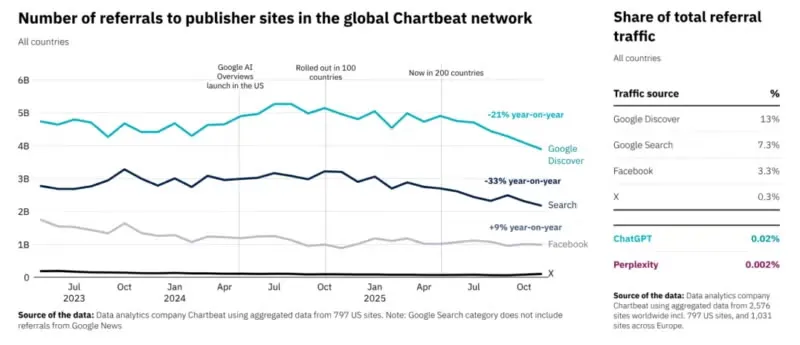
Website referral traffic continues to decline across much of the web, according to new data reported by The Press Gazette and based on Chartbeat and Reuters Institute figures. Global Google search referrals to publishers dropped by roughly one-third year-over-year, with Google Discover down 18% and total external referrals falling by 24%. The trend coincides with the expansion of Google’s AI-powered search previews, which increasingly keep users within the search interface rather than sending them to external websites.
Google has disputed claims that AI previews are significantly reducing outbound traffic, stating that overall organic click volume remains stable and that click quality has improved. However, multiple independent reports suggest that many publishers and brands are experiencing referral declines of 20% to 50%, reinforcing concerns that traditional SEO-driven traffic is becoming less reliable.
At the same time, new research points to a shift in where visibility may be coming from next. Studies from SEMrush and Spotlight indicate that LinkedIn is rapidly emerging as a trusted citation source for AI chatbots such as ChatGPT, Google AI, and Perplexity. LinkedIn now ranks just behind Reddit in overall AI citations, with LinkedIn Pulse articles accounting for the majority of referenced content.
According to Spotlight data, AI tools are citing LinkedIn sources four to five times more frequently than earlier this year. This suggests that platforms perceived as authoritative, professional, and regularly updated are gaining importance as AI-driven search evolves.

For brands and professionals, the takeaway is not to abandon traditional SEO, but to expand visibility strategies. Publishing expertise-driven content directly on LinkedIn, maintaining credible and complete profiles, and participating in niche discussions may increasingly influence how AI systems surface information. As search behavior shifts from links to answers, visibility is no longer just about ranking—it’s about being cited where AI looks for trust.
LinkedIn Users Targeted by New Phishing Scam Using Fake Policy Violation Comments
A new phishing campaign targeting LinkedIn users is spreading through fake “reply” comments posted directly under LinkedIn posts, according to reporting by Bleeping Computer. The scam involves impersonator accounts posing as LinkedIn or LinkedIn-affiliated pages and warning users about alleged policy violations.
The fraudulent comments claim that a user’s account has been temporarily restricted due to supposed violations and urge them to click a link to resolve the issue. To appear legitimate, the messages mimic LinkedIn’s branding and, in some cases, use LinkedIn’s own lnkd.in URL shortener to disguise malicious destinations.
Users who click the links are redirected through multiple phishing sites, where they are asked to “verify their identity.” These pages are designed to harvest login credentials, giving attackers access to LinkedIn accounts. The comments are typically posted by fake company pages using variations of the LinkedIn name, making them harder to spot at a glance.
LinkedIn has confirmed that it is aware of the campaign and is actively working to remove the fraudulent content. The company has reiterated that it does not communicate policy violations via public comments, and that any official account-related notices are sent through private, authenticated channels.
The incident highlights a broader trend in phishing tactics, where attackers increasingly exploit trusted platforms, branding, and built-in features to deceive users. LinkedIn users are advised to be cautious of unsolicited warnings, avoid clicking links that demand urgent action, and report suspicious comments directly to the platform.
The Linked Blog is here to help you or your brand have the best possible LinkedIn presence, so feel free to contact us if you need help! See more about what we can do for you here.