The way people discover information, build careers, and evaluate credibility online is changing faster than most brands and professionals realize. Over the past year, LinkedIn has quietly moved from being “just” a professional network to something far more consequential: a platform where visibility, trust, and authority intersect in an AI-driven internet.
Three developments from the past few days make this shift impossible to ignore. Referral traffic from search engines continues to decline. AI tools are increasingly using LinkedIn as a trusted citation source. And at the same time, the platform is dealing with more sophisticated phishing attacks that exploit that very trust.
Individually, these stories are concerning, interesting, or strategic. Taken together, they tell a much bigger story about where LinkedIn is heading, and what professionals, creators, and brands need to understand if they want to stay visible.
The Slow Decline of Referral Traffic and the End of “Search as We Knew It”
For anyone responsible for driving traffic to a website, the numbers are difficult to ignore. According to reporting based on Chartbeat and Reuters Institute data, global Google search referrals to publishers have declined by roughly one-third year-over-year. Since mid-2023, Google Discover traffic is down 18%, while overall external referrals have dropped by approximately 24%.
The timing is not accidental. These declines closely follow the rollout of Google’s AI-powered search previews, which increasingly answer user queries directly within Google itself. More searches now begin and end without a single click to an external website.

Google has pushed back against the narrative that AI previews are hurting publishers, stating that total organic click volume remains stable and that “click quality” has improved. But independent studies, particularly from publisher-focused sources, consistently show traffic declines ranging from 20% to 50% for many sites. The implication is clear: traditional SEO and referral traffic can no longer be treated as a guaranteed foundation. Visibility is shifting from links to answers, from rankings to citations, and from websites to platforms that AI systems already trust.
Why LinkedIn Is Becoming a Trusted Source for AI Search Results
While referral traffic declines elsewhere, a different trend is emerging. Multiple studies now show that LinkedIn is rapidly becoming one of the most cited platforms in AI-generated responses. According to research compiled by SEMrush, based on the analysis of more than 230,000 AI prompts across ChatGPT, Google AI, and Perplexity, LinkedIn now ranks just behind Reddit in overall AI citations. A separate study by Spotlight reinforces this finding, showing that AI tools are citing LinkedIn content four to five times more often than earlier in the year.
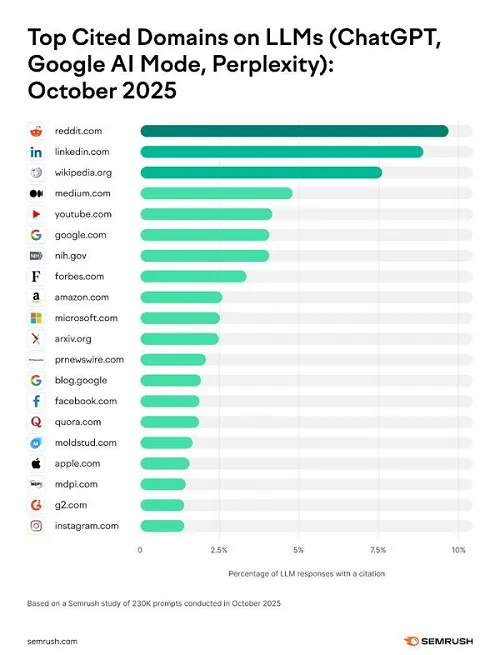
Most notably, the majority of these citations come from LinkedIn Pulse articles, not short posts. This suggests that long-form, expertise-driven content published directly on LinkedIn is increasingly being treated as authoritative source material by large language models.
This matters because AI-driven discovery doesn’t work like traditional search. These systems prioritize perceived authority, consistency, and professional credibility over pure keyword optimization. Verified profiles, complete career histories, and subject-matter relevance likely play a role in how LinkedIn content is selected and surfaced. For brands and individuals alike, this signals a shift from chasing clicks to earning citations. Being visible in AI-generated answers may soon matter as much as being visible in Google search results once did.
Visibility Is No Longer Just About Reach – It’s About Credibility
These three developments point to the same underlying shift. Visibility online is no longer driven purely by volume, frequency, or technical optimization. It is increasingly governed by credibility signals to humans and to machines. AI systems are learning where to look for “reliable” information. Scammers are exploiting platforms that users inherently trust. And search engines are reducing the role of traditional websites in favor of closed ecosystems and direct answers.
In this environment, LinkedIn occupies a unique position. It combines real identities, professional history, long-form publishing, and social proof in a way few other platforms can replicate. That makes it valuable, but also risky, depending on how it’s used.
What This Means for Brands, Creators, and Professionals
For brands, this is a signal to rethink where authority is built. Publishing expertise-driven content directly on LinkedIn is no longer just a distribution tactic it may influence how AI systems represent your brand in search results. For creators and thought leaders, long-form articles and consistent positioning matter more than ever. Posts disappear quickly. Articles compound.
For everyday professionals, profile completeness, verification, and digital hygiene are no longer optional. As LinkedIn becomes a layer of public trust, your profile becomes part of how you are evaluated by people and algorithms alike. And for everyone on the platform, vigilance is essential. Trust should never replace skepticism, especially when messages demand urgency or verification.
The Bigger Shift LinkedIn Represents
LinkedIn is no longer simply a place to network, post updates, or look for jobs. It is evolving into an infrastructure layer for professional credibility in an AI-shaped internet. Search is changing. Authority is being redefined. And trust, once implicit, is now both the platform’s greatest asset and its greatest challenge. Those who understand this shift early won’t just stay visible. They’ll stay relevant.
The Linked Blog is here to help you or your brand have the best possible LinkedIn presence, so feel free to contact us if you need help! See more about what we can do for you here.