LinkedIn rewards conversations, not word counts. If your long-form posts are getting impressions but no comments, the algorithm is already working against you. Here is why the ratio between what you write and what others say back is becoming the most important metric on the platform.
The Metric Nobody Is Tracking
There is no official LinkedIn metric called “comment-to-character ratio”. You will not find it in your analytics dashboard, but if you start measuring it manually, the pattern becomes obvious fast.
Take a 2,000-character post that gets 15 comments versus a 200-character post that gets 15 comments. Both have the same comment count. But the shorter post generated the same level of conversation with a fraction of the content. In terms of engagement efficiency, the shorter post performed dramatically better.
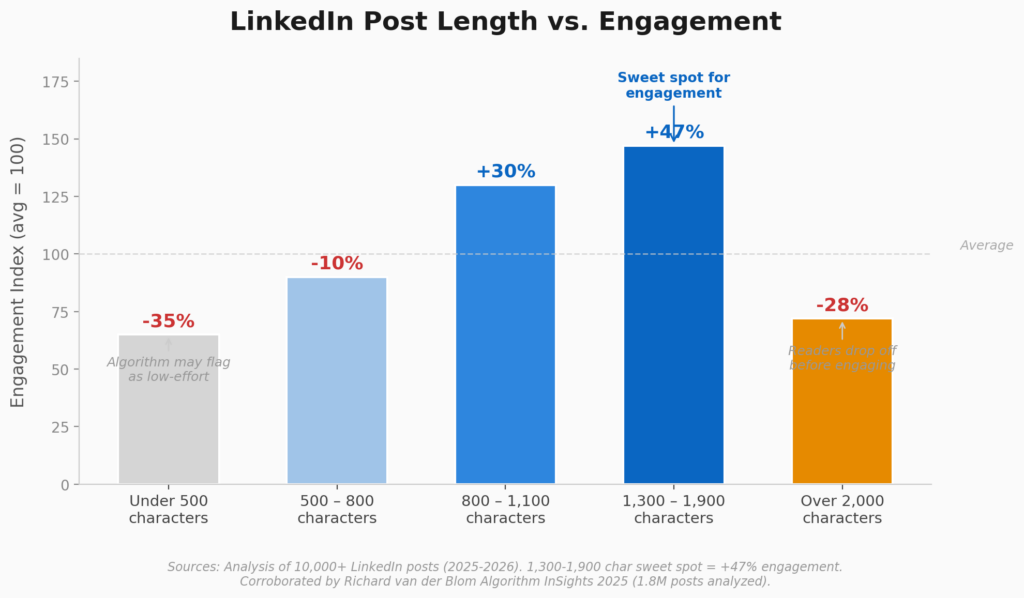
Now reverse the scenario. A 3,000-character post gets 2 comments. A 300-character post gets 12. The long post may have taken an hour to write. The short one took two minutes. But the short one started a conversation. The long one delivered a monologue.
This is the core of the comment-to-character ratio: how much conversation does your content generate relative to how much you wrote? And increasingly, LinkedIn’s algorithm cares about exactly this dynamic — even if it does not use this specific term.
Why the Algorithm Now Favors Conversation Over Length
LinkedIn recently disclosed a series of major updates to its Feed ranking system. As we covered in detail in our analysis of LinkedIn’s next-generation Feed architecture, the platform has moved toward a new ranking infrastructure powered by large language models, transformer-based recommender systems, and real-time behavioral analysis.
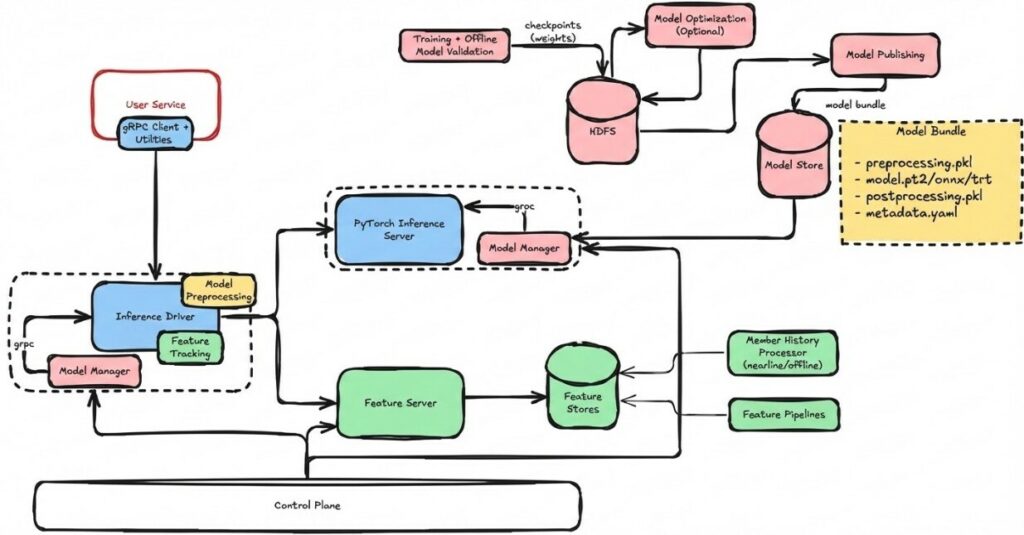
Source: LinkedIn Engineering Blog
The key shift is this: LinkedIn’s ranking models no longer evaluate posts in isolation. The system now processes sequences of user interactions over time, analyzing not just whether someone liked a post, but how they engaged with it, how long they spent on it, and whether it led to further activity on the platform.
Comments are one of the strongest engagement signals in this system. A like is a single binary action, a share is valuable but relatively rare, but a comment represents active participation – a user took the time to formulate a thought, type it out, and contribute to a conversation. From an algorithmic perspective, comments signal that a post generated genuine professional value.
LinkedIn has also explicitly stated that it is reducing the visibility of engagement bait and generic content. Posts that prompt shallow interactions such as “Comment ‘Yes‘ if you agree” are being deprioritized. The platform is actively distinguishing between authentic conversation and manufactured engagement.
This means that the quality and depth of comments matter more than the raw number. Five thoughtful replies from professionals in your industry carry more algorithmic weight than fifty one-word responses triggered by a bait prompt.
The Long Post Problem
Long-form LinkedIn posts are not inherently bad. Some of the most successful content on the platform is detailed, substantive, and well over 1,000 characters. But length creates a specific risk: it can discourage conversation.
When a post reads like a complete essay, readers often consume it passively. They absorb the information, perhaps tap the like button, and scroll on. The post feels finished. There is nothing left to add. The author said everything, and the audience received it as a broadcast rather than an invitation.
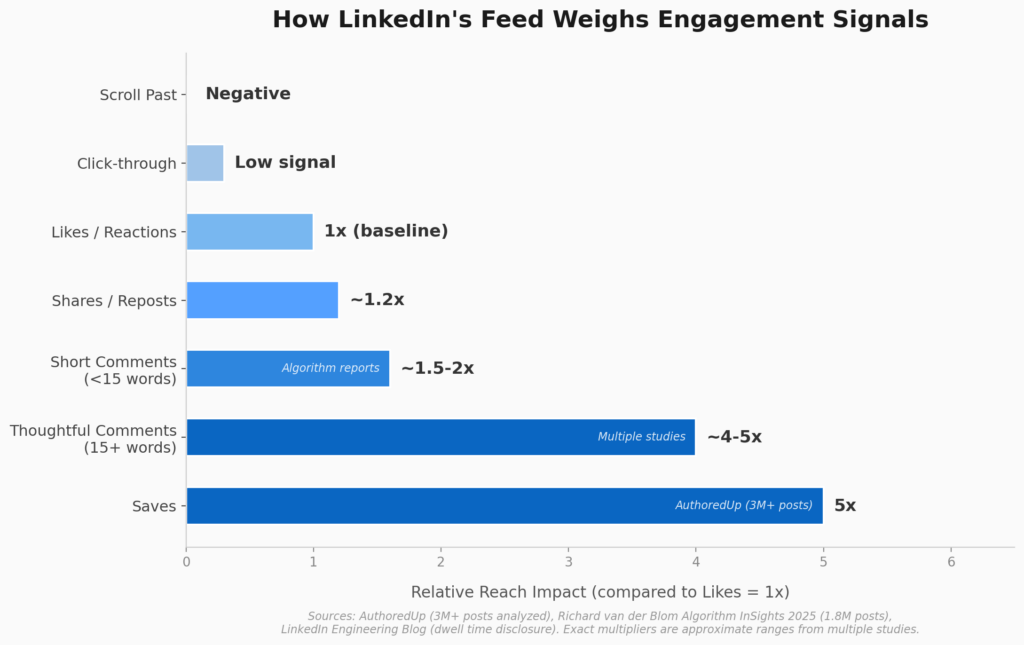
This is where the comment-to-character ratio becomes revealing. A long post with strong engagement might get 50 comments on 2,500 characters. That is a healthy ratio, but a long post that gets 3 comments on 2,500 characters is essentially a lecture delivered to a silent room. The algorithm sees that silence. It interprets the lack of conversation as a signal that the content, while perhaps informative, did not generate the kind of interaction that keeps professionals engaged on the platform.
The problem is compounded by how LinkedIn’s new Generative Recommender model works. This system analyzes sequential engagement patterns. If users consistently read long posts but do not interact with them, the model learns that this type of content does not drive meaningful engagement. Over time, the Feed adapts by surfacing fewer posts with similar characteristics.
In other words, writing long posts that nobody responds to does not just affect that single post. It can gradually reduce the algorithmic reach of your future content.
What Drives Comments on LinkedIn? (and What Kills Them)
Understanding why some posts generate conversation and others do not requires looking at what motivates professionals to comment in the first place. People comment when they feel something is incomplete, when they have a perspective to add, or when the post creates a gap they want to fill. A post that presents a strong opinion invites agreement or disagreement, a post that asks a genuine question invites answers, a post that shares a specific experience invites others to share theirs.
Posts that kill conversation tend to share several characteristics. They are exhaustive, leaving no room for additional perspectives. They are abstract, making it difficult for readers to connect the content to their own experience. Or they are performative, written more for the author’s personal brand than for the audience’s benefit.
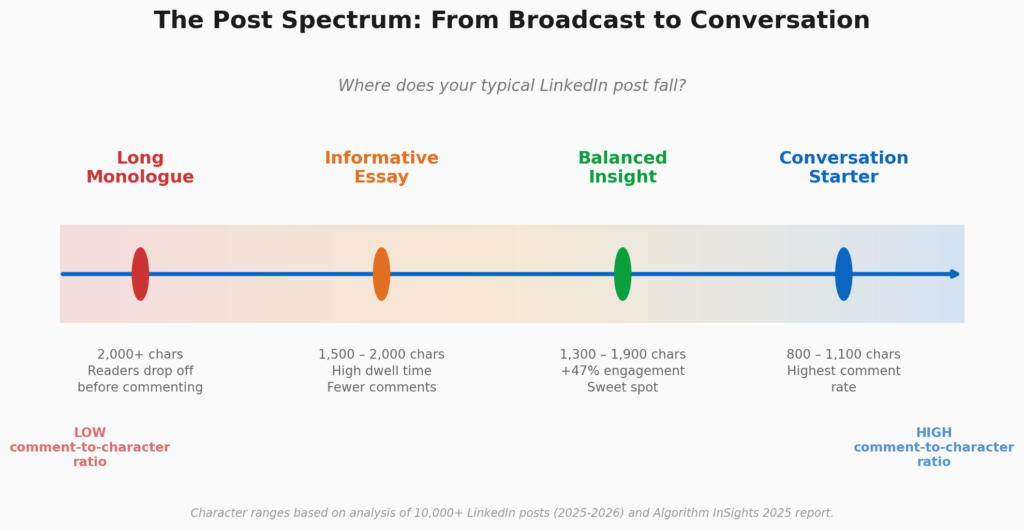
The most effective long-form posts balance depth with openness. They make a clear argument but leave space for others to extend it. They share a specific insight but acknowledge that the topic is larger than any single post can cover. They end with an implicit or explicit invitation to contribute. This is not about artificially shortening your posts. It is about writing with conversation in mind from the first sentence.
How to Improve Your Comment-to-Character Ratio
If you want to track this metric, the calculation is simple: divide the number of comments by the character count of your post. A higher ratio means your content is generating more conversation per unit of content you produced. But improving the ratio is not about gaming numbers. It is about shifting how you think about content creation on LinkedIn.
- Write posts that open conversations, not close them. The strongest LinkedIn posts do not try to say everything about a topic. They say one thing clearly and invite others to build on it. If your post reads like a final statement, rewrite the ending as a starting point.
- Use specificity to trigger recognition. Abstract posts about “leadership” or “innovation” rarely generate meaningful comments because they do not connect to anyone’s specific reality. A post about a specific decision you made in a specific situation gives readers something concrete to respond to.
- Ask real questions, not rhetorical ones. “What do you think?” at the end of a 2,000-character monologue is not a real question. A genuine question emerges from the content itself and requires thought to answer. If the question can be answered with “yes” or “great post,” it is not doing its job.
- Shorten when the post is not earning its length. If your analytics consistently show that your longer posts get fewer comments than your shorter ones, that is a signal. Not every idea needs 2,000 characters. Some of the most engaging LinkedIn posts are under 500 characters because they say one provocative thing and let the audience do the rest.
- Respond to comments to extend the conversation. A post with 10 comments where the author replied to none of them is a missed opportunity. When you engage in your own comment section, you signal to both the algorithm and your audience that the conversation matters. Each reply adds to the overall engagement signal and encourages others to participate.
Why This Matters More in 2026 Than Ever Before
LinkedIn’s algorithm updates in early 2026 have made this dynamic more pronounced than it was even a year ago. The platform’s new ranking infrastructure uses Generative Recommender models that process over 1,000 historical interactions per member to understand engagement trajectories. The system does not just look at whether someone commented on a single post. It tracks patterns across sessions, days, and weeks.
If your content consistently generates comments that lead to further activity – profile visits, follow-on engagement, connection requests – the algorithm interprets your posts as high-value conversation starters. This creates a compounding effect. Posts that spark discussions get distributed more widely, which attracts more engaged audiences, which generates more conversations on future posts.
The opposite is also true. If your posts consistently deliver long-form content that users read but do not respond to, the algorithm gradually learns that your content does not drive the type of engagement LinkedIn is optimizing for. The Feed becomes quieter for you – not because your content is bad, but because it is not generating the signals the system is designed to reward.
LinkedIn has also been actively reducing the reach of automated comments and engagement pod activity, which means that the comments your posts receive need to come from genuine interactions. Artificial inflation of comment counts is becoming less effective and potentially counterproductive, as the platform’s systems are increasingly capable of distinguishing between authentic conversation and coordinated activity.
The Shift From Broadcasting to Facilitating
The comment-to-character ratio is not a vanity metric. It reflects a fundamental shift in how LinkedIn distributes content.
The platform’s new AI-powered ranking systems are designed to identify and promote content that generates authentic professional conversations. Posts that deliver value through dialogue rather than monologue are increasingly favored by the algorithm. LinkedIn’s own engineering team has stated that the Feed is being optimized to surface content that helps professionals learn, share knowledge, and stay connected to opportunity.
For creators and professionals building visibility on LinkedIn, this means the role is changing. The most effective LinkedIn presence is no longer about publishing the most content or writing the longest posts. It is about consistently starting conversations that others want to join.
Track your comment-to-character ratio across your last 20 posts. Look for the pattern. The posts where you wrote less but sparked more discussion are telling you something important about how the platform works now. The Feed is listening. Not to how much you say, but to how much others say back.fessional platforms are increasingly built not just on information, but on habit.
The Linked Blog is here to help you or your brand have the best possible LinkedIn presence, so feel free to contact us if you need help! See more about what we can do for you here.