There was a time when calling yourself a strategist carried weight. It suggested years of experience, difficult decisions, measurable outcomes, and the ability to connect vision with execution. Today, a quick scroll through LinkedIn paints a very different picture. Overnight, everyone appears to have become an AI strategist, growth strategist, marketing strategist, innovation strategist, or leadership expert. Every day, thousands of posts confidently explain what companies should do, what leaders are getting wrong, or the five lessons learned from an ordinary life event.
The problem isn’t that more professionals are sharing ideas. In many ways, that’s one of LinkedIn’s greatest strengths. The challenge is that as publishing became easier and generative AI dramatically reduced the effort required to produce polished content, genuine expertise became increasingly difficult to distinguish from well-written opinion. The result is a growing wave of what could be called thought-fillers: content that looks like thought leadership, follows every best practice, but contributes very little that’s genuinely original.
This isn’t simply a cultural phenomenon. It’s the outcome of changing platform incentives, advances in artificial intelligence, and a recommendation algorithm that is now trying to solve a problem it unintentionally helped create.
How LinkedIn Rewarded Everyone to Become a Thought Leader
Over the past several years, LinkedIn transformed into one of the most powerful creator platforms in the professional world. Personal profiles began outperforming company pages, authentic storytelling consistently generated engagement, and professionals realized that publishing regularly could build visibility far beyond their existing network.
The formula quickly became predictable. Successful posts usually followed the same structure:
- Start with a bold hook
- Add a personal anecdote
- Finish with a business lesson
- Invite discussion
There was nothing inherently wrong with this framework. It encouraged professionals to share experiences, lowered the barriers to publishing, and made expertise more accessible across industries. But once thousands of creators began using the exact same format, differentiation slowly disappeared.
Then generative AI arrived.
Tools like ChatGPT, Microsoft Copilot, Claude, and LinkedIn’s own AI writing assistants made producing professional-looking content almost effortless. Instead of spending an hour developing an original perspective, users could generate an entire post in seconds. The barrier to publishing effectively disappeared. Predictably, LinkedIn didn’t just receive more content. It received an unprecedented volume of content that sounded authoritative, looked polished, but was often built on recycled frameworks and generalized advice rather than lived experience.

When Everyone Sounds Like an Expert, Nobody Stands Out
The issue isn’t that AI writes poorly. Quite the opposite. Modern language models are remarkably good at producing fluent, structured, and persuasive text. The challenge is that they learn from patterns, and those same patterns have gradually come to dominate LinkedIn itself.
Scroll through the platform today and you’ll find remarkably similar posts discussing leadership, AI, productivity, company culture, or career advice. Different authors often arrive at nearly identical conclusions, supported by the same storytelling structure and familiar motivational language. The writing feels professional, yet surprisingly interchangeable.
Recent research highlighted by Business Insider illustrates just how quickly this transformation has happened. Between April and June 2026, approximately 41% of long-form LinkedIn posts and 30% of shorter posts were estimated to have been generated with AI assistance. Among the major social platforms analyzed, LinkedIn showed one of the highest concentrations of AI-generated professional content.
That statistic doesn’t necessarily imply lower quality. It does, however, explain why originality has become increasingly scarce. Professional content has never been easier to create, while authentic expertise has never been more difficult to identify. As more professionals publish content optimized for engagement instead of insight, the Feed becomes increasingly filled with opinions that sound credible but rarely move the conversation forward.
LinkedIn Has Started Fighting the Problem
Ironically, LinkedIn itself has become increasingly vocal about the unintended consequences of AI-generated content. After spending the last two years embedding AI across its products, the company is now trying to prevent those same tools from flooding the platform with repetitive, low-value posts.
In May 2026, Laura Lorenzetti, LinkedIn’s Global Editorial VP, announced new initiatives aimed at reducing the visibility of generic AI-generated content. While the platform continues encouraging AI as a writing assistant, it has made it clear that posts lacking genuine perspective or original insight will receive less distribution, particularly outside a creator’s immediate network.

Among the most significant platform updates are:
- Reduced reach for generic AI-generated posts
- Stronger detection of automated comments
- Continued action against engagement pods
- Lower visibility for recycled thought leadership
- Less distribution for engagement bait and repetitive posting formats
According to LinkedIn, early testing showed that its systems were able to identify low-value AI-generated content with approximately 94% accuracy. While no automated detection system is perfect, the announcement reflects a broader strategic shift. The platform is no longer optimizing simply for activity. It is increasingly optimizing for credibility.
The Algorithm Is Learning the Difference Between Expertise and Opinion
Behind these product announcements lies an even bigger technological transformation. Earlier this year, LinkedIn Engineering revealed details of its next-generation Feed recommendation system, one of the most significant changes to content distribution since LinkedIn began prioritizing creator-led publishing.
Instead of relying primarily on engagement metrics or keyword matching, the platform now uses transformer models, Large Language Models (LLMs), and Generative Recommenders capable of understanding the semantic meaning of content. Rather than asking whether a post contains popular keywords or generated strong engagement yesterday, the system evaluates whether a creator consistently demonstrates expertise within a particular domain. More about the topic can be found in one of our latest articles in The Linked Blog about a new KPI: Comment-to-Character Ratio.
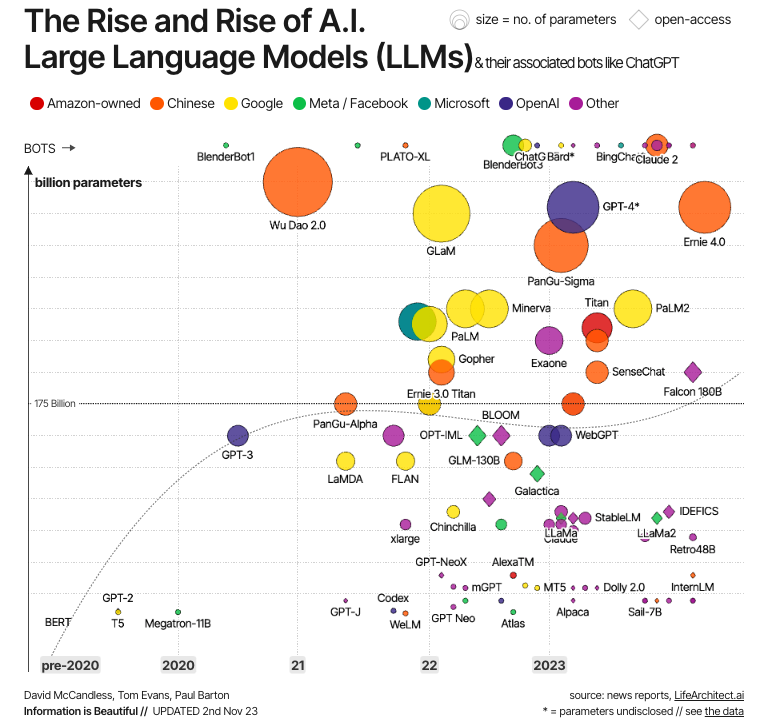
According to LinkedIn Engineering, the recommendation system now serves more than 1.3 billion members while processing over 1,000 historical interactions per user to understand evolving professional interests. The algorithm evaluates signals including industry, work history, skills, topical consistency, engagement history, and long-term interests before recommending content to wider audiences.
The implication is significant. Chasing trends may generate occasional visibility, but long-term authority increasingly comes from consistently demonstrating knowledge rather than producing isolated viral posts.
New Research Suggests LinkedIn Has Become the Most AI-Saturated Social Platform
If there were still doubts about how deeply AI has reshaped professional content, new research from Pangram adds another compelling data point. Based on more than 1 million social media posts scanned between April and July 2026, LinkedIn emerged as the platform with the highest concentration of AI-generated long-form content. While LinkedIn posts represented roughly one-third of all scanned content, they accounted for 62% of every AI-generated post detected across the entire dataset.
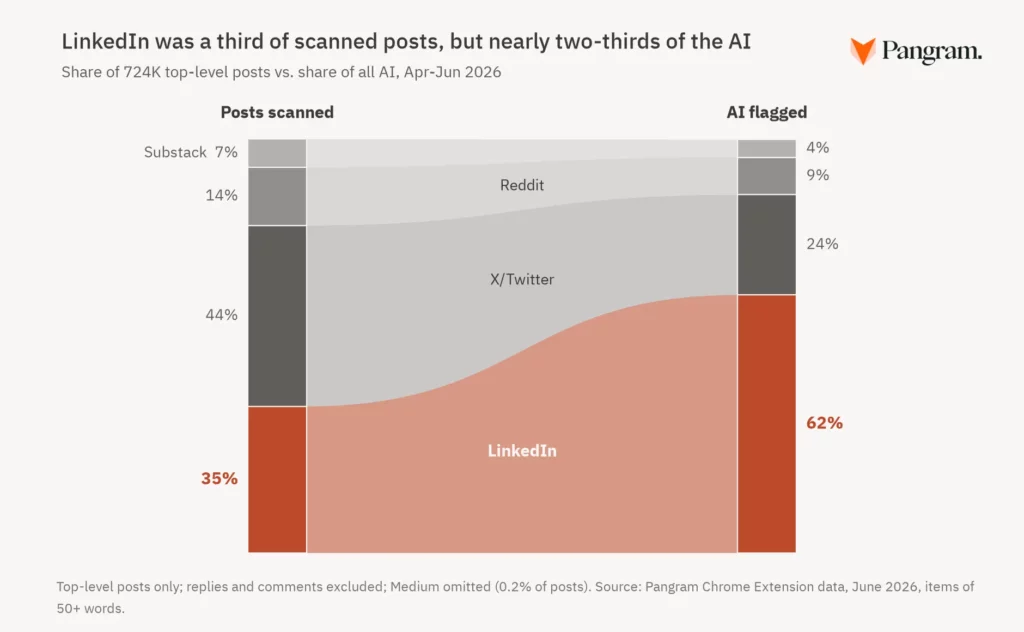
The findings become even more striking when looking specifically at long-form publishing. According to Pangram’s analysis, more than 40% of LinkedIn posts longer than 250 words were classified as fully AI-generated. Across all social platforms included in the study, approximately one in four long-form posts (25.7%) appeared to be entirely AI-written, reinforcing the idea that AI adoption is accelerating fastest where professional expertise is expected to be most visible.
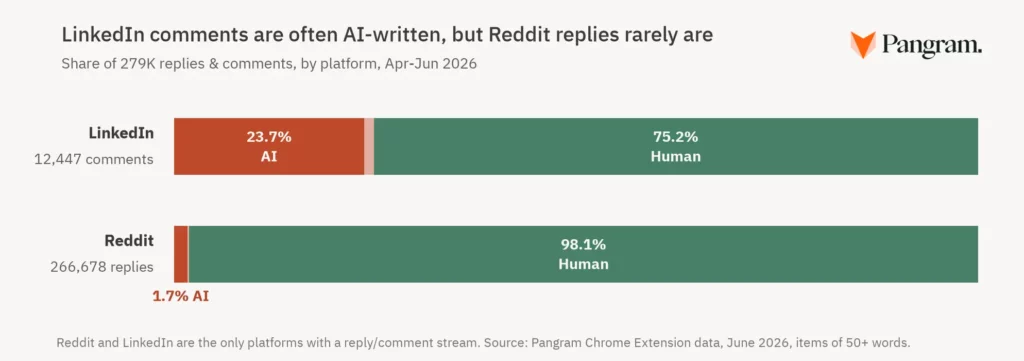
Interestingly, the research also found that top-level LinkedIn posts were 1.35 times more likely to be AI-generated than comments, suggesting that users are far more comfortable relying on AI when publishing thought leadership than when participating in actual conversations. In other words, while discussions on the platform remain relatively human, much of what initiates those discussions is increasingly being written by machines.
Expertise Is Becoming More Difficult to Fake
One of the most fascinating aspects of LinkedIn’s new recommendation architecture is how it understands professional knowledge. Traditional recommendation systems relied heavily on keywords and behavioral similarities. Today’s AI-powered Feed uses semantic embeddings that recognize relationships between concepts, industries, and disciplines rather than simply matching words.
For example, an engineer regularly discussing electrical infrastructure may now be surfaced alongside conversations about renewable energy or modular nuclear reactors, even if those exact phrases never appeared in previous posts. The system increasingly understands context instead of vocabulary.
This evolution means consistency matters more than ever. Professionals who continuously publish experience-based perspectives are likely to benefit, while creators relying on generalized advice across constantly changing topics may find it increasingly difficult to build lasting authority.
What is the real problem on LinkedIn?
It would be easy to blame artificial intelligence for this trend, but that would ignore the bigger picture. LinkedIn itself continues expanding AI across almost every part of the platform, including profile optimization, content creation, advertising, recruitment, campaign management, and Feed recommendations. The company’s vision clearly isn’t to reduce AI adoption. It’s to improve how professionals use it.
The distinction lies in how these tools are used. LinkedIn repeatedly emphasizes that AI should support professionals in communicating their own ideas, not generate expertise they don’t possess. Laura Lorenzetti summarized this perfectly when she explained that the ultimate value still comes from the human behind the tool.
The challenge, therefore, isn’t artificial intelligence itself. It’s artificial authority. AI can accelerate writing, improve structure, and remove friction from the creative process, but it cannot replace judgment, curiosity, lived experience, or original thinking. Those qualities remain fundamentally human.
The Future Belongs to Demonstrated Expertise
Perhaps the biggest shift taking place on LinkedIn isn’t technological at all. It’s cultural. For years, the platform rewarded appearing knowledgeable. Today, it increasingly rewards consistently demonstrating knowledge over time. That subtle distinction changes everything. Visibility is becoming less dependent on mastering content frameworks and more dependent on building genuine professional authority that both algorithms and audiences can recognize. An example of sharing knowledgeable content can be seen below by the founder of BookMark – Alexander Krastev, sharing more information about the right data to measure on the platform.

The professionals most likely to succeed in this environment won’t necessarily be those publishing the most content. They’ll be the ones sharing ideas rooted in real work, practical experience, informed judgment, and continuous learning. AI can certainly help refine ideas, improve clarity, and remove friction from the writing process, but it cannot manufacture credibility.
The rise of thought-fillers may have been an inevitable consequence of creator culture colliding with generative AI. Yet LinkedIn’s latest platform changes suggest that the next era of professional content will reward something far more difficult to fake than polished writing. It will reward professionals who have something genuinely worth saying.
The Linked Blog is here to help you or your brand have the best possible LinkedIn presence, so feel free to contact us if you need help! See more about what we can do for you here.