AI is changing LinkedIn in two directions at once. The platform is becoming increasingly valuable for demonstrating AI expertise, while also dealing with the consequences of AI-generated content becoming cheap and abundant.
This week’s developments capture that tension particularly well. LinkedIn users are actively pushing back against low-value AI content, professionals are rewriting old experience to match today’s demand for AI skills, and new labor-market research shows that the opportunities created by the technology are far from evenly distributed.
More Than 1 Million People Have Flagged “AI Slop” on LinkedIn
Less than a month after LinkedIn introduced its “Seems like AI slop” button on July 30, more than 1 million users have already used it to flag content they consider low-quality and largely AI-generated.
The experiment is also beginning to affect distribution. According to LinkedIn’s CPO, posts receiving enough AI-slop signals are seeing approximately 40% fewer views. The platform combines these reports with its own detection systems and has begun notifying authors through analytics when their posts receive enough negative signals.
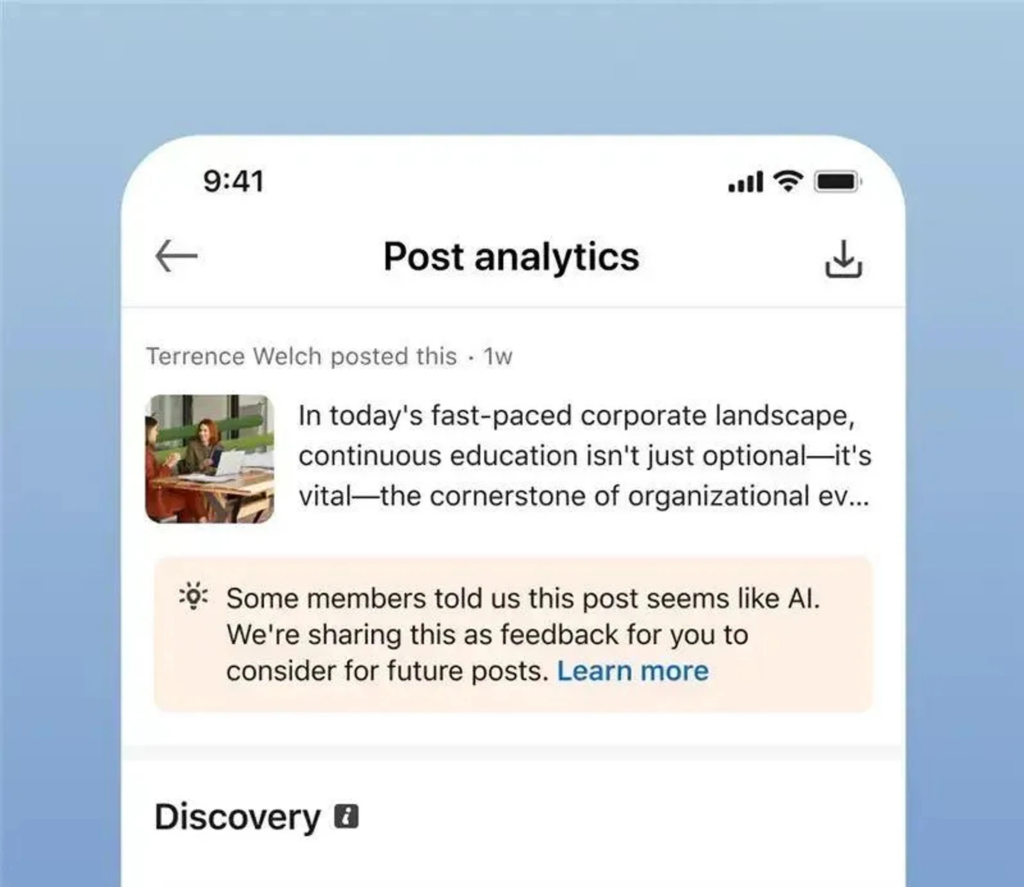
Importantly, LinkedIn isn’t targeting AI-assisted writing itself. The focus is on content produced at scale with little human input or value, continuing the platform’s earlier efforts to reduce automated, low-quality comments.
The scale of participation suggests LinkedIn has found a problem users genuinely recognize. More importantly, the 40% reach reduction turns that feedback into a meaningful distribution signal. Using AI may be increasingly normal on LinkedIn, but publishing something that feels automated and disposable could increasingly come with an algorithmic cost.
LinkedIn Profiles Are Being Rewritten to Match What Employers Want
LinkedIn profiles may look like records of professional history, but new research suggests that history is more flexible than we might assume.
A National Bureau of Economic Research working paper analyzing monthly snapshots of 4 million U.S. LinkedIn profiles found that nearly one-fifth had retroactively changed the title or description of a previous job. Researchers call the phenomenon “time travel”, with the median edit occurring more than four years after the job had ended.
What people change is particularly revealing. Since ChatGPT’s release, retroactive additions of terms including AI, GPT, LLM and artificial intelligence have increased more than sixfold. At the same time, workers have become less likely to add or more likely to remove language associated with remote work and DEI as employer priorities have shifted.
That doesn’t necessarily mean people are inventing experience. As the researchers note, workers may simply be describing old responsibilities using terminology that employers now understand and value.
But it creates an interesting measurement problem. The researchers estimate that using a 2026 LinkedIn snapshot to understand the workforce of 2022 would overstate the prevalence of AI-related skills by around 30%. LinkedIn profiles therefore reveal more than what people have done. Increasingly, they reveal what professionals believe the market wants them to have done.
Women Account for Just 26% of U.S. AI Hires
AI is producing some of the fastest-growing and highest-paying opportunities in the labor market, but LinkedIn’s latest research suggests access to them remains highly uneven.
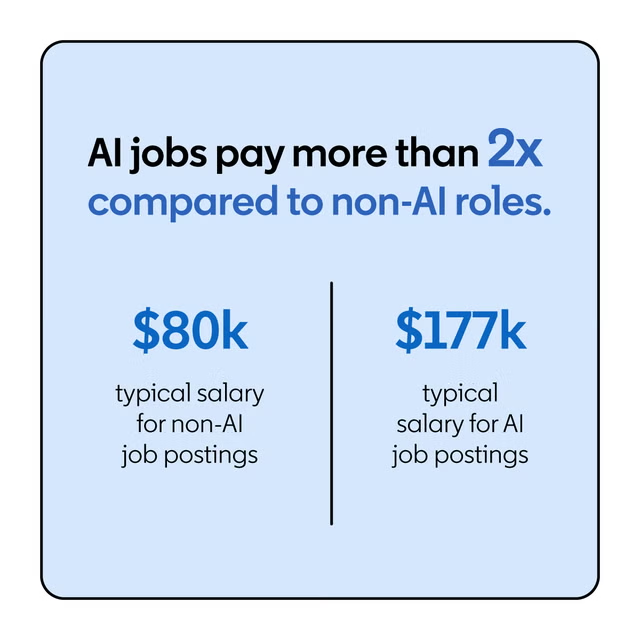
In the U.S., AI job postings have roughly doubled since 2023, while the typical AI vacancy lists around $177,000 in compensation, compared with $80,000 for a non-AI position. Yet women accounted for only 26% of U.S. AI hires in 2025, versus 50% of hires in non-AI occupations.
The disparity becomes even greater toward the top. Across 27 countries studied by LinkedIn, women occupy only 13% of C-suite AI leadership positions at AI companies. Representation is also low in individual high-paying roles, including Head of AI and Director of AI.
There is an education divide as well. 91% of AI workers hold at least a bachelor’s degree, with the proportion exceeding 95% in several of the highest-paid AI occupations.
AI is clearly creating significant economic opportunity. The rise of roles such as AI Engineer and the roughly sixfold increase in VP of AI postings make that visible. LinkedIn’s findings, however, highlight a parallel question: as an entirely new layer of the labor market forms around AI, who actually gets access to it?
The Linked Blog is here to help you or your brand have the best possible LinkedIn presence, so feel free to contact us if you need help! See more about what we can do for you here.