The way professional information is discovered online is changing, and LinkedIn increasingly wants to shape what happens before the click. As AI tools become research engines in their own right, the content professionals publish — and the authority attached to their names — is starting to matter far beyond the LinkedIn feed.
This edition looks at that shift from two angles: new research on who actually drives LinkedIn citations in AI search, and LinkedIn’s own playbook for adapting B2B content to this new discovery environment. A separate corporate update also shows how the company is concentrating resources internally.
75% of LinkedIn AI Citations Come From Individual Profiles
New research from Meltwater and LinkedIn analyzed 9.5 million AI citations across B2B categories and found that 75% of LinkedIn citations came from individual member profiles, versus 25% from company pages.
The study suggests AI systems favor content with expertise, structure, context, and hard data. Among the top-cited articles in the sample, all used bullets or numbered lists, 92% had clear heading structures, and 67% included statistics.
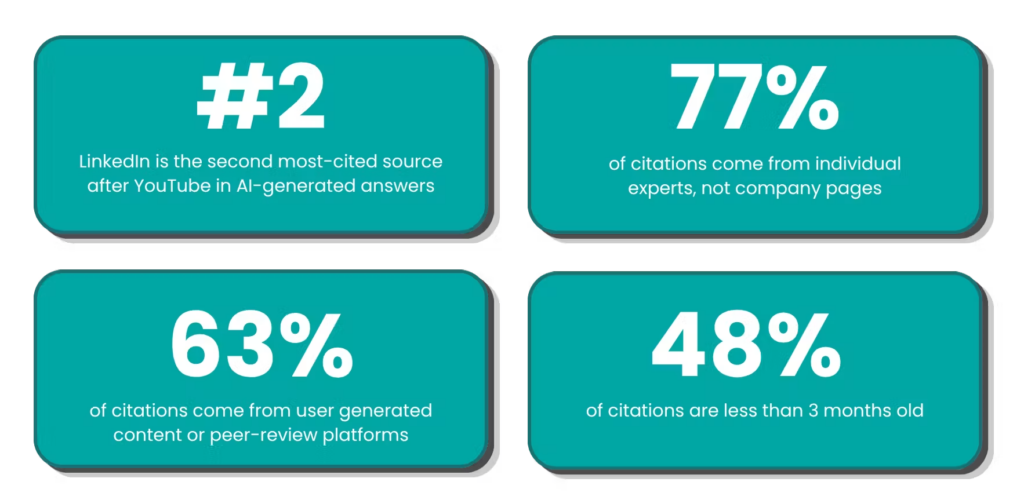
Source: Meltwater
The finding strengthens the case for treating employee expertise as part of brand visibility. Executives, specialists, researchers, and customer-facing teams can create authority signals that may travel far beyond their immediate LinkedIn audience.
LinkedIn Publishes Its Own AI Search Playbook
LinkedIn is now explicitly advising B2B marketers on how to adapt to AI-powered discovery.
In its new guide, Unlocking AI Search Visibility: the B2B Marketer’s Guide to LinkedIn, the company argues that buyer research is increasingly happening inside tools such as ChatGPT, Gemini, Copilot, and Perplexity, often before users ever reach a company website. LinkedIn also points to research showing it is now the most-cited domain for professional queries across major AI-search platforms.
Source: LinkedIn
The guide recommends building content around a small number of core topics, activating executives and subject-matter experts, and coordinating social, PR, editorial, and marketing activity. It also notes that articles generate roughly 60% of LinkedIn content citations, while posts account for around 40%.
The bigger shift is in measurement. LinkedIn recommends tracking citations, share of voice, citation rank, and sentiment, rather than relying only on traffic, rankings, and engagement.
LinkedIn Is Closing Its Tel Aviv Development Center
LinkedIn is reportedly closing its Tel Aviv development center and laying off nearly all of its roughly 50 employees, with a small number expected to stay temporarily to support ongoing activity.
The office was opened after LinkedIn’s 2022 acquisition of Israeli analytics startup Oribi, reportedly valued at around $80 million to $90 million. At the time, LinkedIn said Oribi would strengthen Marketing Solutions through better attribution, conversion measurement, and audience-building tools.
A LinkedIn spokesperson said the company is proposing changes to some roles as it focuses teams around its top priorities. The closure comes during a broader period of cost-cutting at Microsoft, although current reporting does not establish a direct link between those wider layoffs and the decision in Tel Aviv.
The move marks a notable reversal four years after the acquisition, and comes as LinkedIn continues investing heavily in AI, advertising, hiring tools, and professional discovery.
The Linked Blog is here to help you or your brand have the best possible LinkedIn presence, so feel free to contact us if you need help! See more about what we can do for you here.