LinkedIn is making some unusually visible changes to how people discover content, build relationships, and search for work. In each case, the platform is trying to make intent clearer: what you want to see, who you want to connect with, and what kind of job you are actually looking for.
This week brings an apparent new feed experiment, fresh research on Gen Z’s relationship with professional networking, and a major change to LinkedIn Jobs that will eventually replace the platform’s traditional search experience.
LinkedIn Is Testing Separate “For You” and “Network” Feeds
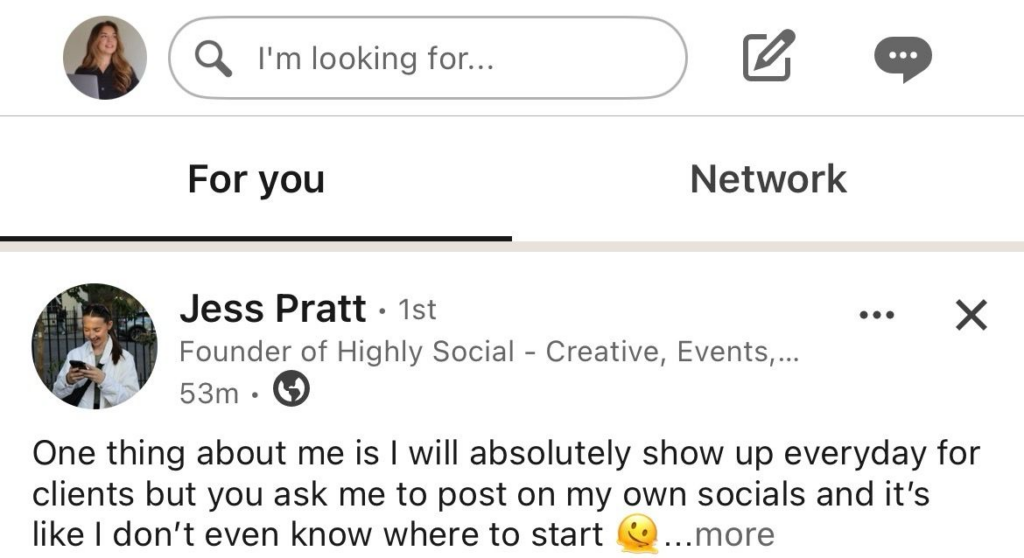
Some LinkedIn users are beginning to see a new distinction inside the feed: “For You” and “Network”.
The change has been spotted by users on the platform, although LinkedIn has not yet announced a broad rollout. Based on the early observations, “For You” appears to lean toward content discovery, while “Network” gives members a clearer way to catch up with people they already follow or are connected to.
It is a small interface change with a potentially bigger implication. LinkedIn has spent years moving beyond the traditional connection-based feed and recommending more content based on interests, expertise, and relevance. A visible separation between discovery and network content would make that transition much more explicit.
For creators and brands, that makes positioning even more important. If LinkedIn is increasingly deciding whether a post belongs in an interest-driven discovery environment or primarily within someone’s existing network, being clear about what you talk about, who it is for, and why you are credible on that topic becomes harder to ignore.
For now, this should be treated as an observed feature or test rather than a confirmed platform-wide change. But it fits closely with the direction LinkedIn’s feed has already been moving in.
72% of Gen Z Feel Disconnected From People Who Could Help Their Careers
Gen Z may have grown up constantly connected online, but LinkedIn’s latest research suggests that professional networking remains surprisingly difficult for many of them.
In a study of more than 18,000 professionals and 6,000 marketers, LinkedIn found that 72% of Gen Z professionals feel disconnected from people who could help their careers. More than half are unsure how to get started building professional relationships, while common concerns include bothering people, being judged, and sounding inauthentic.
That matters because relationships can have a measurable impact on opportunity. LinkedIn says U.S. applicants with an inside connection were nearly 7x more likely to get hired, while 27% of Gen Z professionals said they had found their next opportunity through online professional communities.
At the same time, Gen Z is becoming increasingly important on the other side of the table. 89% of B2B marketers surveyed said future growth depends on influencing Gen Z and Millennial decision-makers.
The research therefore points to an interesting contradiction. Gen Z is becoming more influential professionally while many younger workers still lack confidence navigating the relationships that could help them advance. For brands, the same trust gap matters too: expert voices, peers, and professional communities appear increasingly important in influencing how younger buyers evaluate companies.
LinkedIn Is Retiring Classic Job Search
LinkedIn’s new AI-powered job search is now available to all members worldwide, and the company says it will begin gradually retiring its classic job search experience.
Instead of relying primarily on exact job titles, keywords, and filters, members can describe what they want in natural language. A search could be as specific as “finance manager roles in my network with less than 10 applicants,” with LinkedIn interpreting the intent and matching it against millions of job descriptions.
The system uses large language models fine-tuned on two decades of LinkedIn data. That means it can understand related roles even when a listing does not contain the exact words a candidate typed. Someone searching for “entry-level marketing jobs,” for example, could also see titles such as Marketing Coordinator or Junior Marketing Associate.
Traditional filters are not disappearing entirely. LinkedIn is retaining options including company, experience level, employment type, remote work, and number of applicants, with several additional filters due to return.
What is disappearing is the old assumption that job seekers need to know exactly which keywords employers have used. LinkedIn is moving job discovery toward intent-based search, where users explain what they want and the platform interprets the request for them.
The Linked Blog is here to help you or your brand have the best possible LinkedIn presence, so feel free to contact us if you need help! See more about what we can do for you here.